One Clear Path

Dream wakes me with words,
“Pay attention! One clear path —“
(So many directions.)

***

The labyrinth calls. 
One path in,
One path out. 
Twists and turns,
Facing all the directions,
In the center place, a nest —

Searching for the one way,
The one thing,
The word, the phrase,
The workshop, the quote,
The “once and for always”
obsessive narrowing of focus.
The pathway to bliss,
Peace and presence assured,
Pain kept at bay.

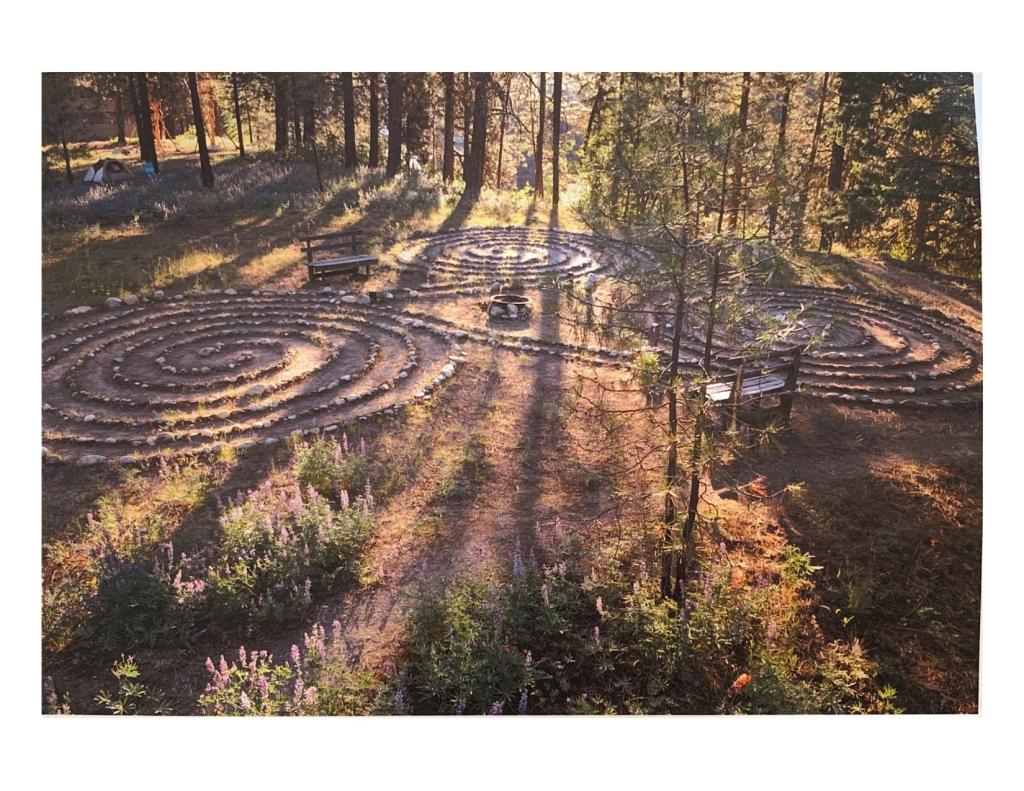
I yearn for the Celtic path,
A triple spiral,
One continuous path,
Just three turns in one circuit.
A deeper stillness,
A singular path
To the nest within me.

What if focus could be a deepening,
A compassionate returning,
Again and again, 
To the radiant spark within,
A practice of breathing,
Stopping, 
Resting,
Releasing,
Opening,
Receiving,
Repairing,
Rejoicing.

Then returning and re-engaging,
Each time with more ease,
To what is close and essential,
Yet also — strangely —
To what is larger and more complex.

Amidst the difficulties
And the chaos
And the untoward —

…….My dog in his last days,
…………His suffering eyes,
…….My body aching with each step,
…………Each bend an agony,
…….My heart yearning,
…………For simple acts of love.

Amidst all of that,
I come back to 
The one I am becoming,
The one who pauses
To breathe in courage
And love
Then turns to face
What is.

Here I am.

Some days I don’t want to write something lyrical and beautiful. I just feel cranky, and I wonder what a cranky poem would sound like. And then the voices come in with all their disparate views.

“You shouldn’t feel cranky. You have so much to be grateful for. So just stop!”

“I feel what I feel. I shouldn’t deny it just because it’s not ‘nice.’”

“What’s really wrong? What’s underneath all this darkness?”

“Look, I’m tired And my back hurts. And it’s painful to climb the stairs. Everything in my body hurts. And no amount of Tylenol or Advil make it go away.”

“Right, and you are particularly good at avoiding the exercises the PT suggested. Maybe if you were more disciplined.”

Then I remember my last session with Alison and the horses. Remember that this is the time to breathe. Not rejecting those voices. Just breathing. 

Remembering the source of those voices. The time after my father died and before I became a rebellious teenager. A young girl of 9 or 10. The nightmare years. 

Those voices — whether self-critical or complaining or pained or cranky  — they come from a time when I was most broken, most alone, and trying to survive. Wishing I could die but trying to find a way to live. 

Much of my creativity in that time was expressed in writing and bookmaking. I searched magazines and greeting cards and music lyrics for words and images that would comfort me, inspire me. But mostly, just keep me alive.

I searched for hope. Hope that these terrible, wrenching sobs that lived deep inside me would somehow stop haunting me. I wanted to bury the darkness with words of goodness, of love, of something or someone that would come and rescue me from the unending weight of my life.

I can tell that story and feel the desperation building in me again. Of course, I learned to try hard, to please everyone, to manage everything. Of course I learned to anticipate trouble and create systems to keep everything on an even keel. Of course I understood who was feeling what in every room I entered and immediately tried to fix whatever needed fixing.

Of course I cared deeply for the ones who were lost, who had no voice, who were dependent on absent adults. Of course — if I could save them, perhaps someone would see me and save me.

All of that began to turn when a horse named Parome stood with me one day while I remembered that time of deep grief. He stood stock still while the deep wracking sobs shook my body. While I felt all the pain I’d been trying to fix. He stayed with me until I could breathe again and see myself in a different way.

I didn’t need saving. That girl of 9 or 10 didn’t need to be swept away from her grief. She did need someone to see her, stay with her, sit beside her, be with her.

Today, I am that person. When the crankiness shows up, I’m here to be with that part of me who is hurting and discouraged. The part that wants to manage and control. The part that wants to be better, do better, dispel the darkness. Be more disciplined. Try harder.

Today, I am the part of me, the self that breathes into the pain. That invites the despair to sit down and rest. That gathers all the broken parts into her lap and begins to sing a wordless song of gathering, of belonging, of being-with.

I am here. I am whole. I am standing with the one I am becoming.
Stones — becoming an “artist”

With a lot of support from others, I went to “art camp” this summer. My passion for making art is fairly recent, probably within the last 5 years. I credit the part of me I call Little B, the young girl part of me that emerged in conversation with my therapist as I processed all that occurred in my childhood to create the no-longer-functional aspects of my adult life. I wanted freedom from the constraints of those patterns, wanted to live a life of more joy, more connection. It required radical change. Little B came along to help me.

She is irrepressible. Exuberant joy in every part of her being. And it quickly became apparent that she loves art. Everything about it. It took awhile for the grown-up in me to reconcile my “lack” of actual experience and training in the visual arts with Little B’s insistence on playing with all the things …

I’ve been writing since I was a child. Poems, stories, essays, fiction, memoir. That was a medium in which I felt comfortable. But Little B wanted more, much more.

I found a place called the Grunewald Guild that seemed perfect for me. Their tagline — art + faith + community — seemed to match my inclinations. Plus, they had a triple spiral labyrinth on the grounds. And a river nearby. And an orientation to Spirit and belonging that resonated with my soul.

I’d been there a few times before the pandemic and loved it. During the pandemic, the Guild offered a number of online classes. And people I met through the Guild also offered visual journaling with favorite books, e.g., Cole Arthur Riley’s This Here Flesh. I was hooked! Post-pandemic, I’ve participated in a weekly Cyber Studio, maintaining my links with the friends I met through the Guild.

Through the generosity of a Guild friend and several cost-saving measures, I was able to book myself into two back-to-back residential experiences at the Guild this summer. I wanted to give myself more experience and practice in drawing so signed up for “Drawing from Where You Are” and “Connecting Hand, Eye, and Soul Through Nature Drawing.” Both taught by deeply compassionate and creative instructors. One was completely pencil and paper, the other ink pen and watercolor. A good blend, I thought.

In the beginning, my “try hard to do it right” adult was still present and active. And as I set about creating a drawing of this composition of stones as an exercise in “shading and value,” I was asking for guidance each step of the way. Which pencil should I use for this? How can I make it look rough? Should I use a different shading technique for each stone (to make it more interesting)?

I was offered choices but not advice. I could use vine charcoal or I could put down graphite and soften it with a blending tool. Test it out in my sketch book, see what I like. One suggestion from an instructor: What calls to me in this particular stone? (and bring out that particular part). I progressed from trying to make it look exactly like the image to making NOT an exact replica but something more … something that looked “interesting” to my eye.

As I gained confidence, I stopped asking for advice. I tried out different things. Tested different techniques. Chose the one that appealed to me.

Little B was very happy.

It took several days. Each stone was several hours worth of work. But the time was fulfilling. I cancelled my subscriptions to several streaming services. No need for “distraction” when my time was filled with art-making.

I think it’s finished. The way a poem is mostly finished but maybe a tweak here or there over time.

And I see that I’ve created a work of art. I feel like I can actually call myself an artist, without disclaimers.

And now what? Do I frame it? Hang it on a wall? Give it away?

I did sign it. Sort of. A smallish, stylized S- in the lower right hand corner. “I, Saoirse, did this.”

I am becoming an artist.

Hummingbird

Hummingbird

Feeder hangs empty.
Buzzing hummingbird seeks food
for tiny belly.

******

The feeder sits empty,
a chore not yet accomplished,
not yet in the rhythm
after being away.

The feeder hangs 
beyond my reach,
requires retrieval of both
ladder and nectar.

Sometimes it’s too hot,
sometimes too wet,
sometimes I’m just
tired. 

Tiny bird body
buzzes from one feeder
to the next,
searching for sustenance.

I see the need.
But still I sit,
tied to the chair
by my own buzzing busy-ness.

Tiny bird body
tries again.
The buzzing
feels frantic.

This time, I rise
from the shackles 
of the chair
that binds me.

After all,
what is more important
than the hunger
of this one tiny being?

Was he watching?
Did the sweetness
of the nectar
fill the air?

Within seconds,
tiny iridescent body returns,
dips his beak
again and again.

Vibrancy lives in you,
little one.
Bright, quick, sweet —
la dolce vita.

Messenger of joy,
sate your hunger
here.

Embracing My Place

“If you can embrace your place in the web of existence, you will always be original. Let your task be simple: rise, and deliver the message you were sent to carry.” — “Dictation,” in The Magpie Art.

I’ve been writing since I was in elementary school — poems, short stories, haiku. I’ve also been creating books and collections of stories and songs and memories and images. I like to edit stories partly because I like to shape the presentation of the story into something with visual impact. The form of a thing matters to me. I’ve learned to let go of what others might settle for in pursuit of “saving time and effort” but I know what pleases my eye. So when I have the chance, I like to shape the visual impact of a poem, the sweep of fabric on the altar, the shape of a bird’s wing on the page.

This summer, I took two multi-day classes in drawing at a retreat setting in the state of Washington (the Grunewald Guild). Drawing from Where You Are and Connecting Eye, Hand, and Soul through Nature Drawing. I wanted to give myself the gift of experience that would expand my options in my own visual art efforts. The people around me are often already experienced and accomplished in various media. So I often feel like I’m the kindergarten student in a classroom of high school seniors. They bring the sophistication; I bring the joy.

Mostly, I’m happy with that role. I bring the joy of playing outside my comfort zone. I risk the comparison of seeing my simple work alongside the more skilled efforts of my peers. My reach often exceeds my grasp. I like what I am doing, however. I like being in learning mode. I like discovering what happens when I explore different media. I also like discovering what the eye of my heart and mind is drawn to. Vibrant colors, simple lines to suggest more than can be seen, a suggestion of energy in a color or a swirl or even an empty space.

As the days progressed, I experienced myself making decisions about composition, line placement and weight, internal and external space. I exercised my eyes and my hands. I tried one way, then another. I allowed myself to experiment. I discovered that lines have a rhythm I could tap into. I played with colors, letting some drift along an invisible boundary and creating connections between others. I built a network of sensations and feelings and images wrapped up in what I would label a “nest” for myself as a visual artist. A place where I am comfortable, resting in the cushion of various strands of experience and realizations. 

As my classes came to an end, I recognized a shift in the way I see myself in the realm of art and art making. From this unfolding sense of wholeness within my self, I can express the connection between eye, hand, and soul. I can deliver the message that is mine to offer, carrying healing into the world through the creative expression of my Heart’s song. Sometimes in words, and sometimes in lines and color.

Tending the Fire

I’ve been reading The Magpie Art: Gathering the Brightness of Each Day by Paul Weinfield. You get a lot of choices with this book. You can read it as a daybook of thoughts about the “brightness” of life, as a progression of thoughts through a season (e.g., Love/Spring, Appreciation/Summer, ), or by themes (e.g., clarity, creativity, anxiety). I’m currently moving sequentially through Summer, taking the themes as they come. There’s something about letting a reading come to you in its time, searching for the glimmer of gold that’s meant just for you in this day, this time, this season. 

Today’s offering was titled “The Cook and the Fire.” Right off, the author asserts that creativity and joy are the same thing. Instead of buying into the meme of the struggling artist and the joyful consumer, he urges the reader to remember that the art of connecting to creativity and joy is the art of discerning, in every moment, the difference between what you must do and what you must allow. A cook selects, prepares, and cares for the ingredients but doesn’t actually cook them. That is the work of the fire. 

The fire of creativity or joy must be tended for the work to be accomplished. Whether by writers or painters or meditators, the fire must be left to do its work while the writer/painter/meditator prepares the “ingredients.” We (yes, I am all of those) have only to take a moment to remember the flame and let it work through us. Further, I believe we tend to the fire of joy as an act of love in the world — the world of creation that is, ultimately, a testament to life and its fertility.

Body Wisdom

Last night, I participated in a “breathwork practice for integrating embodied presence.” <https://workwithlibby.com/breathwork/> As I settled into the practice, an email exchange with my mother earlier in the day came into my awareness. 

She’d written about her many worries that day: four separate situations and people ranging from why the orioles aren’t taking as much grape jelly to the unpredictability of which day the person who mows her lawn will show up. My mother is 92 years old, lives alone on her “farm,” often sleeps poorly, and feels guilty if she takes an afternoon nap. 

I responded to a variety of things in her email but also commented on her worries, expressing my hope that she might let go of what she could and trust that she is held in God’s loving embrace no matter what. 

Her reply defended her response. She’s a “realist,” wants to understand the world around her, being informed helps her understand things better. As I continued the breathwork, I realized my mother felt judged by my encouragement to let go of her worries and trust that all would be well.

I recognized my words to my mother were actually words to the part of me that is like my mother, an attempt to manage and “correct” my own anxieties. For years, I’ve known that when my body feels tight across the back of my shoulders, I am worried about something, feeling anxious. In the past, the tension in the back of my shoulders was like hardened concrete, and it took a long time for it to crack apart and — eventually — soften.

As the breathwork practice continued, I breathed into the tightness I was feeling in the back of my shoulders. Not to make it go away, just noticing and breathing.

I asked myself the question often prompted by my therapist. What does this part of me need to hear? This part that is like my mother, carries worries and anxieties, creates tension across the back of my shoulders. In response, I assured this “mother part” — and my shoulders — that I was here, I was with her, I would stay right here.

It was as if this wise, integrated self was sitting with this “anxious mother part” of me, holding a reassuring hand to her back, talking softly in short phrases, holding her with my presence.

Gradually, the tightness across the back of my shoulders loosened, and the anxious, worried feeling abated. The “mother part” of me and wisdom part of me were quiet, present in the softness. 

I regret trying to manage my mother’s feelings. I wish I had simply acknowledged her worries. I tried to “fix” her. Of course, I want her to feel less anxious. She’s worked hard, still works hard. She deserves to rest, to feel good about herself. But that’s not for me to manage. I hope I can “come alongside” her feelings with more awareness in the future.

As for me, it’s helpful to recognize that I still try to manage my own worries and anxieties. I am still judging those feelings, rejecting them. I may always have that impulse, both to manage and to judge. Yes, I have other choices now. And judging and rejecting aspects of my being are not helpful to the process of opening up my life to more joy, more freedom. Being aware, being “with” … always helpful.

I’m grateful for the opening and the insight afforded me in this time of integrating embodied presence. And I’m grateful for increased awareness of this “mother part” of me. 

Integration. Embodiment. Presence. Powerful words. I continue to marvel at the wisdom my body offers me.

bliss

stepping into day
light radiates within me
each moment brings joy

******

there’s a kind of gratitude
that seeps into the body
permeates the cells
becomes the life-blood
of each moment

this kind of gratitude
once experienced
does not fade away
when challenges
arise

this kind of gratitude
takes up residence
waves away all efforts
to diminish
or dissuade

once seated within
the heart leaps up
to do the work
that must
be done.

the process of growth
unfolds
takes hold
sees gains
that last

patience
persistence
wisdom
flow
freely

yes life still contains
loss and pain
suffering and sorrow
we mourn
cry out in grief

in the moment
we shed tears
feel the sadness
rend our hearts
groan in despair

still
embers of joy
glow softly
waiting
to be stirred.

Words from Ordinary Time

Some days ago I picked a word from a little pile of words to write about, think about, notice it’s presence in my life … you know, the thing you do when you are inevitably and perpetually drawn to the practice of contemplation and exploration of all things spiritual. 

That word was “light.”

Perfect, I thought. Leonard Cohen’s “Anthem” came to mind:

Ring the bells that still can ring
Forget your perfect offering
There is a crack, a crack in everything
That’s how the light gets in.

The light of God? The light of our better nature? The light that comes when we give up our tightly managed control?

I don’t question that allowing for the cracks in life and letting the light in is a good thing. For me. For anyone.

But I’m a person of privilege. I am not enslaved nor impoverished. I am white, well-educated, gifted in many ways with confidence, intelligence, creativity. A woman, yes. Which in the eyes of the Southern Baptist leadership is a lesser being. But really, being a white Southern man can be its own kind of prison. 

Still, the concept of “light” remains ethereal. Elusive. Not of this world.

This morning I drew another word. 

“Solid.”

Perfect, I thought. The ground beneath my feet. The place I come back to, again and again. The place I can rely on.

And still, I wander in the realms of what it means to stand on solid ground. My faith in what I cannot see? That stepping into the unknown where I can trust I will be held? Found? Carried?

Maybe a little less ethereal. Still somewhat elusive. And probably falls into the category of “Be in the world but not of it.”

I have a faith that serves me, grounds me. I have a great therapist. I’ve been growing, evolving, transforming, becoming a person of depth, resilience, presence.

Still, I like the balance between “light” and “solid.”

Maybe that’s another word for me to consider: balance.

I can find the light, even “be” the light sometimes. For myself, for others. I can also stand on principle, on what is “real,” on the certitude of hope.

I can be in sorrow, even suffering, without drowning. I can be in joy without losing sight of the brokenness of the world. 

So, yes. I’ll ring the bells, laugh at my imperfection, and embrace the cracks of life.

******

What is the balance
Between the ground and the light?
Become ringing bells.